Welcome to longlines. Notes, photos and articles from Europe, America, the Middle East, Australia and the Pacific will be posted here. All comments are welcome.

Saturday, May 15, 2010

Colour and light in Burano


Burano has been home to commercial fishermen since at least the sixth century AD. The houses of Burano were painted bright contrasting colours, it is said, so that fishermen could find their way home in the fogs that sometimes settle over the Venetian lagoon. Today, however the Venetian council controls which colours the houses may be painted, and Burano offers more than cuttlefish cooked in its own ink as a local treat.

From the vaporetto the leaning tower of the sixth century San Martino church, whose interior houses a painting of the crucifixion by Tiepolo the elder, is the first indication that Burano is coming into view.

The soft mud and clay of the flood plains and islands of Northern Italy is the foundation upon which numerous towers and campaniles have been built. This geological feature has led to a proliferation of leaning towers and the consequent architectural innovation of building towers separate from the main buildings. These towers topple when subsiding foundations send the fragile balance of the leaning structure to the point of collapse.

Burano has more to offer the visitor, however, than a leaning tower.

We must give Hemingway his due. There is indeed something distinctly feminine about Burano. All those lace and fabric shops might have something to do with this impression, plus the brightly coloured houses, the abundance of tea and coffee shops. But perhaps it is more to do with the women, women everywhere, from toddlers to great-grandmothers, women of all shapes and sizes, yet with one thing in common - wide welcoming smiles, encouraging each and every visitor to come, view her textiles, drink her coffee, taste her baked goods.

Burano was the poor relation in the Venetian lagoon for centuries. In Roman times it was an outlying village of Torcello. Its star rose during the peak of the trade in lace, after which it reverted to being just another lagoon island.

Today Burano is a trendy address for the well heeled in the European art and design world. Phillipe Starcke, the French designer whose furniture features on the long running American television series Boston Legal is reputed to own a number of houses on the Island.

The island has its own art movement, the Burano School, established in 1910 when a group of artists moved there and, inspired by nineteenth century French schools of painting, adopted a “simple poetic rendition of the landscape” through modern use of colour, and a stripping back of sentimentality. Ironic when one considers the history of the Lagoon Islands and the effect of the French on their history.

In A Venetian Island: Environment History and Change in Burano, Sciama emphasises that Burano is separate and different from Venice, although ‘part of Venice’s administrative and bureaucratic structure’, the island’s relationship with Venice is ‘changing and complex’, with its own ‘strong kinship links’.

Burano’s size and place in the lagoon may have helped develop its own distinct style. The district of Burano is over 50 square kilometres in area, the second largest district in the lagoon, although only half a square kilometre of that area is dry land.

Burano is part of a small triangle formed with the islands Torcello and Mazzorbo. Burano had links and loyalties to Torcello long before Venice even existed. It is also connected by a flat pedestrian bridge to Mazzorbo which is home to the 14th century church of Santa Caterina.

Santa Caterina, Catherine of Alexandria, was reputedly one of the most intelligent and beautiful woman of her day. She was beheaded by the pagan ruler of Alexandria in 305 AD at the age of 23 after being tortured by being splayed on a wheel.

The Crusaders brought the story of Catherine to Europe. The Catherine Wheel (both the children’s gymnastic feat and the fireworks) and the Catherine or Rose window were named after her. Catherine’s ability to defeat philosophers in argument was not celebrated. Instead she became the protector of young unmarried girls. The wheel of her torture became the symbol for wheelwrights, spinners and lace-makers.

Of course, in due course, the French not only lured lacemakers from Burano but also established their own rival protector of young girls and lace makers, the French priest, St John Francis Regis. John Francis’ life and times are more prosaic and more based in fact than those of Catherine.

Whether or not it is the beneficence of Catherine wafting across oceans and mountains and one thousand seven hundred years of time or some other quality in the light and the hospitality of its inhabitants, Burano is an island the visitor can imagine settling into. It is tempting to wonder what life would be like to wake in its small hotel, take a dawn walk over the bridge through the parks of Mazzorbo, drink morning coffee at tables along its cobbled streets, or just sit by the canal each evening and watch the sun set over the lagoon.

Observer
15 May 2010
Blog: Longlines - http://longline8.blogspot.com/
Email: longline8@gmail.com

Tuesday, May 11, 2010

Points in the Air: Lacemaking on Burano


Lacemaking was one of the early ‘women’s industries’, a means by which many women achieved a measure of financial independence.  Before the French broke the Venetians’ control of the lacemaking industry Burano was one of the main centres of lacemaking in Europe.

 The  Burano vaporetto stop is a small ferry terminal opening to a wide, grassy, treed area on which children play under the watchful eyes of grandmothers, and where youths lounge around waiting for the excitement of whatever will arrive from the other islands.  

After a ferry trip in which drunken men sparred – a display more of linguistic than physical abilty – the sense of space under a blue spring sky was a relief, an escape.

Burano is famous for lacemaking.  Authentic Burano lace is no longer sold in the town's street stalls. Burano lace is now a luxury item, priced according to the time and skill that goes into its making.


Much of the lace sold in Burano shops is today made to order in countries where labour is cheap.

The visitor can still watch lace being stitched in the Scuola dei Merletti (School of Lacemaking) whose museum traces the history of lacemaking on Burano. 

Burano’s lacemaking tradition evolved from the influence of Venetian imports of gold and coloured embroideries from the East.  These inspired Venetian craftswomen who supplied the church cloths and vestments.  They developed white embroidery to trim these items.  Needlepoint lace developed from white embroidery.

The first lacemaking is, in spite of competing claims from orientalists, Francophiles and the numerous other voices clamouring for recognition of their area, not really known.  Many forms of decorative fabric trim were in existence long before true lace evolved. 

But it is interesting that the two regions of Europe where pictorial art flourished in conjunction with great trading skills, north Italy and Flanders, were where lace making first evolved as an important industry.


Lace came into being at the end of the fifteenth century and lace designs evolved from embroidery designs.

The first needle lacers were Venetian.  In the 16th century Venetian women realized the monetary value of lace.  It was not only nuns cloistered in convents who made lace.  The women of Venice filled their palaces with relatives and servants and bales of thread from Salo on the shores of Lake Garda.  They produced lace edgings by the thousands of metres to trim cuffs, collars, hems because, in the early days, lace was used as a trim.  

These relatives and servants in turn began making lace at home and the skill spread to the islands.

Lace was a non-perishable product, that could be made in spare moments in the course of a woman’s day.  It was not dependent on timing or the season or the weather. 

Soon Murano, Chioggia, Burano and Pellestrina set up schools.  The translation of the Italian ‘scuola’ to the English ‘schools’ is confusing.  Italian ‘scuola’ were artisans’ guilds with strict rules and control over the products made under their auspices.  The scuola controlled who worked in the guilds, who trained the artisans and how, who sold the products, to whom and for how much.

In the sixteenth century the women of Burano developed a fine, delicate form of lace known as “punto in aria” (“points in the air”) which transformed the island into one of the most prosperous lacemaking centres in Europe.  Burano represented the standard for lacemaking in Europe until the end of the 18th century 

During the 17th century women broke away from the strict rules that had grown up around lacemaking for the church and developed new styles.

But within the mercantile spirit lies the seeds of its own destruction.  The Venetian Republic aspired to become the publishing capital of Europe and the Venetian dialect had been adopted as the official language of lace makers. 

Printers, authors and designers of manuals on lace making emerged on the fondamentas, salizadas, calles, campos and cortes of Venice.  Guides to lace making were published and became best sellers.  Outside Italy these guides were copied and translated or written by expatriate Venetians.

Those wily French and Flemish lace makers soon were providing serious competition for the women of Burano.  In order to encourage home-based industries the French imposed duty on imported lace and established their own factories for making all types of thread work.  The Venetians responded with their own import duties and bans.

From the 18th century lace became a commercial enterprise. Venetian lace makers were paid large sums of money to go to France to work in the lace factories there.  The Venetian Republic retaliated by introducing laws against the emigration of lace workers, as they had done previously with the glassworkers of Murano. 

The conquest of Venice in 1797, and the subsequent collapse of its commercial power, resulted in the economic ruination of Burano and by implication of Burano’s women and children, although Burano was already declining as a lacemaking centre.  In 1872 the present day lace-making school was founded in the hope that it would revive the island’s former fortunes, but buyers were not prepared to pay a living wage to the lace makers. 

Nineteenth century male writers seemed to take particular pleasure in recounting stories about Burano’s women and children, beautiful yet reduced to aggressive begging.

An article published in the New York Times on 2nd July 1880 typifies this writing:

“[We] soon drew up in a bad smelling canal, before a dirty broad street or narrow marketplace, ... we pushed our way through the crowd of begging children to the lace school.  We were accompanied all the way by one particular dirty little girl ... who begged persistently and dolefully. ...

In spite of being unable to locate finished pieces of lace to purchase the writer found at least one compensation for the trip to the island:

The Buranese women are among the prettiest we have seen in North Italy.  When we went back to the gondola, we found the landing swarming with beggars.  We were paddled away from Burano, followed along the sides of the canal by the troop of begging children among whom the frowsty-pated little girl was still prominent and quite unabashed by her utter want of success.”

It is almost certain that canals throughout the lagoon smelt badly in those days.  They still are not that fragrant.  One only wishes the ‘frowsty-pated little girl’ had flung great handfuls of mud from the stinking canal onto the backs of the mean-spirited but doubtless well scented retreating tourists.

Observer
11 May 2010
http://www.longline8.blogspot.com
Email:  longline8@gmail.com

Note: 
There is an enormous amount of information about lace and Burano on the web.  There is also an almost equal amount of printed literature on the lace makers of Burano.  Below is just a sample listing.  
http://www.museocaprai.it/en/index.htm
http://www.topak.cz/text/en/history.aspx


The Project Gutenberg EBook of The Art of Modern Lace Making, by The Butterick Publishing Co. 

(Good for techniques and styles of lacemaking, but with dubious historical information)


Migration, Minorities, and Technology Transfer in Early Modern Europe* by Salvatore Ciriacono, University of Padua

 New York Times Archive for 1880
The Sciama book is an excellent sociological study 

Saturday, May 1, 2010

On the Way to Burano

The trip from Venice to Burano takes a little under an hour and is a pleasant way to observe some of the lesser known islands of the Venetian Lagoon. These islands are treasure troves for the archaeologist. They have been the locus of important moments in Venetian history. For the visitor with a few days to spare and a copy of the Actv vaporetto timetable they can be engaging and rewarding destinations.
On the way to the vaporetto stop for Burano we passed the first spring crocuses dancing in the wind in the Giardini Papadopouli. Filaments of cloud spun across a cerulean sky. At the changeover stop at Fondamente Nuove a brisk breeze ruffled the waters of the Rio dei Gesuiti.

It seemed a perfect day to visit the island that Hemingway described as the feminine equivalent of Murano, to drift across the lagoon in the wake of Byron, Shelley, James Fenimore Cooper - the armies of tourists and visitors who had plied the route since the days of the Romans. Burano as Henry James said, is “a pretext … for a day on the lagoon”.

A self guided tour group from New York and a group of locals returning to Burano packed into the vessel. Inside the cabin, the air was thick with the fug of humanity overlaid with wafts of expensive perfume, stale cigarette smoke and wine. Obviously somewhere in Venice wine was being dished out in generous amounts early in the morning.

After the requisite amount of jostling those few individuals not belonging to either group were squashed in the middle. A young Venetian man, his English girlfriend and a scattering of other nationalities gazed across a sea of heads at the lagoon beyond windows that were firmly shut against the outside world.
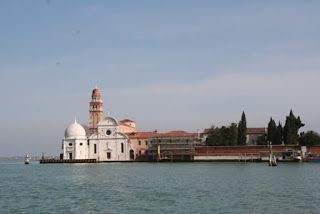

The vaporetto chugged past San Michele, the cemetery island of Venice where the remains of only a privileged few find permanent rest. The less fortunate being consigned, after a suitable period of interment, to the charnel house.

Reflections on the reality of death in the lagoon were interrupted as Vignole floated green and lush far to starboard, a reminder that even Venetian vegetables grow on islands.


No one went ashore on Murano, but more Burano-bound passengers squeezed on board. There was standing room only. This was off-season. Where had the information that few people visited Burano come from?

As we departed Murano the ferry in front of ours turned south-east to wend its way through channels cut through the mud flats that have protected the island of St Erasmo for millennia.

Then someone opened a window. Wind gusted through the cabin. A man began yelling in heavily accented English. An American on the starboard side shouted back. The window was slammed shut.

The two men leapt to their feet, trading insults across the heads of startled passengers, cutting off the view of Isola San Giacomo in Palude on the port side and of Isola Lazzaretto Nuovo on the starboard.

Ancient Greek and Roman artefacts have been unearthed on these islands. But it is their history as ‘plague’ islands and later as military installations that links the two.

San Giacomo in Palude, or “paluo”, (St James in the Marsh) was originally a Cistercian convent. During the plague of 1456 lepers were moved from San Lazzaro to San Giacomo. At some stage the convent was transformed to a Franciscan monastery and remained so until Napoleon dismantled most of the religious institutions on the lagoon islands. He transformed the island into a garrison and it served a military purpose for various armies until 1964.

Lazzaretto Nuovo was Venice's second quarantine island. Around the turn of the first millennium the monks of Saint Giorgio Maggiore built the church of Saint Bartholomew on the island and it became known as Vigna Murada (the walled vineyard). In 1468 the island was renamed Lazzaretto Nuovo, to differentiate it from the first quarantine station which now became known as Lazzaretto Vecchio.

All incoming merchant vessels, their crew and cargo had to be processed here. Life for ships’ crews temporarily quarantined on the island was usually comfortable. However anyone from the merchant ships who exhibited signs of the plague was summarily removed to Lazzaretto Vecchio and certain death.

Periodically, plague victims were brought from Venice and left to die on Lazzaretto Nuovo. Some historians believe that at least eight thousand people died here from the plague.

Napoleon’s, and later the Austrians’, enthusiasm for military installations saw Lazzaretto Nuovo reborn as a gunpowder store and it remained in military hands until 1975.

Through all of these changes the herons and egrets have maintained their still and careful fishing in the marshes surrounding these islands.


However ancient and natural history were far from the minds of the passengers aboard this vaporetto on an early spring morning in 2010. A modern blood feud seemed to be evolving. Loyalties were being established.

Voices were raised in support of the protagonist, or against the antagonist. The air was thick with testosterone.

The New Yorkers adopted shock tactics and engaged their foe in Italian. There was a momentary silence as the opposing side absorbed this surprise blow.

Then someone flung out insults in dialect. Touché. The Americans, however, were prepared and responded in kind.

Translations were muttered for the benefit of the neutral centre who understood neither Italian nor dialect.

The welfare of ‘the children’ – sturdy young men and women accompanying their older, and presumably more responsible family members on tour or home to Burano – was at stake.

American ‘children’ apparently cannot tolerate closed windows, Buranelli ‘children’ wilt in the wind.

What a fine linguistic display it was!

San Francesco Deserto slipped by unnoticed by most
.
This island had been inhabited intermittently since at least the first century.

In 1220 Francis of Assissi, accompanied by Brother Elias, Francis’ friend and supporter during difficult times, hastened back from a peacemaking mission in the Middle East to avert a crisis in his congregation in Europe.

Like all travellers from the East he passed through the Venetian Lagoon. Over the following few years Francis grappled with the problems besetting his congregation before returning to the Middle East in 1223. Here he instituted the practice of erecting a nativity scene at Christmas time to illustrate to the faithful the extent of the poverty in which Christ was born.

Earlier in this same year Jacopo Michiel, a relative of the Doge of Venice donated the island to the Franciscan order.

However Francis’ desire for peace among men of all faiths and nationalities was not being celebrated by the passengers on the vaporetto.

Calls on both sides for the captain to intervene and control the opposing party were studiously ignored. No actual physical contact between the two parties had occurred. But there was much pacing and milling and waving of fists to accompany the shouting. The vessel remained well balanced as each side aligned port and starboard.

Isola di Crevan, of which all that is known is the dubious fact that its oysters are safer to eat than those from islands closer to Venice, slipped by as the vaporetto turned into the channel leading to the Burano stop.

At the disembarkation point each group determined to beat the other on shore. A bottleneck ensued. Old ladies sitting under the trees in the park beside the vaporetto stop rose, curious, ready to participate in whatever drama was coming ashore. The boatman yelled a few exasperated words. Whether it was his words or the shock of fresh air and a blue sky is not entirely clear, but the arguing stopped as suddenly as it began.

One group of the antagonists headed for the public housing units on Mazzorbo. They glanced back as they crossed the footbridge that connects the two islands at the opposition who had proven such worthy adversaries.
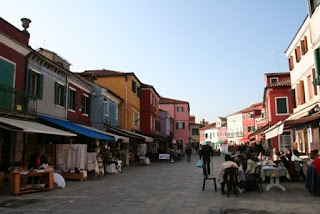
The Americans headed for the cafes.

Had this, after all, been just an opportunity for an international family squabble to be made public?

No one cared any more.

Women in black surged from the entrance to Fondamenta Pontinello inviting the disembarking passengers to come into their village, purchase lace and embroidery, tea and cake.

The sun was shining, the canal sparkled, the brightly painted houses glistened. The air was clean and sweet. A filigree of cloud flitted across the sky.

There was lace everywhere, draped from doorways, across display tables, in shop windows. Business was going to be brisk.

Observer

1 May 2010
Note:  The map, as all my maps are, is a 'mud map' and is for reference only.  Not to be used for boating in the lagoon!
References:
Website for Actv Servizio Navigazione Linee urbane
Canticle of the Sun, Francis of Assisi
Italian Hours, Henry James

Thursday, April 15, 2010

Murano Glass


They have been making glass for over 700 years.  The industry has survived invasions, competition, wars, the invention of plastic, changing fashions, and previous economic collapse.  In spite of the broken windows in the abandoned foundries, the rotting boards on the docks that speak of hard times being endured on the island, it is difficult to believe that Murano will not once again undergo a revival of its craft

The shrine was made of glass: a glass mosaic Virgin and Child in the Byzantine style.  The floral offerings on the ledge below the icon were moulded glass in red, pink, yellow, orange, and blue.  The virgin bore her child like a medallion on her chest.  Her glance, alert, almost fearful was caught by something to her right.  Her gaze, intense yet distracted, rendered irrelevant the opulent ornamentation surrounding her.  What, the observer could only wonder, was she looking at?  On this damp grey day in early spring the shrine gleamed, refracting the light caught by the glass mosaics.

On Fondamente Cavour the shop windows glowed.  Glass in a myriad of colours and forms illuminated the town’s shopfronts.

It is glass that lures Venice’s visitors on the 40 minute vaporetto trip to the island of Murano.

Glassmaking probably began in Mesopotamia 4,500 years ago, but it was the Romans who industrialized it.  During that period glassmakers travelled throughout the empire freely exchanging ideas and techniques.

Twenty years after the death of Jesus Christ, the technique that revolutionized glass production, glassblowing, was developed in Jerusalem.  Glassmaking became a portable industry, producing lighter weight vessels than the available pottery and metal.  It was cheaper as well, for glass is easy to recycle.

Some historians believe the original glassworkers of Northern Italy were descendants of freed Syrian and Judean slaves who spread their craft through the Roman Empire.  Whoever these early craftsmen were, the tradition of glassmaking has deep roots in the area.  By the first century AD Northern Italy was exporting small coloured glass bowls.

In Hemingway’s Across the River and Into the Trees Richard Cantrell extols the masculine virtues of the Muranese – their resilience, their fishing and duck hunting skills, their fecundity. 

With its rows of solid brick buildings along the seafront and the workmanlike steel bridge over Murano’s Grand Canal, there is something masculine about Murano, in spite of its delicate, dazzling products.

Yet Murano’s early history is not about glass.  Unlike the nearby island of Torcello, during the first millennium Murano produced no glass.  The Muranese were refugees from besieged Roman cities, hunters, fishermen, salt harvesters and boatmen.

The Via Annia, a Roman road followed the Adriatic coast as far as the glassmaking centre of Aquileia.  The road passed through the ancient settlement of Altinum, and here it came close to the shore of the Venetian lagoon, close to the inner lagoon islands, including Murano.

Refugees from Altinum escaped Attila the Hun’s invasion of Italy in 452 A.D. by fleeing to these sparsely populated islands.  Within a few decades twelve of the lagoon communities, including Murano, formed a cooperative council, the first step towards a Venetian Republic.
,
When the Lombards invaded Northern Italy in 568 A.D. refugees once again streamed onto the lagoon islands and the Muranese continued to work as fishermen, salt traders, hunters of the waterbirds that abounded in the shallow backwaters of the lagoon.  They also controlled the port on the nearby island of St Erasmo and generated income by servicing and trading with vessels that used the port.

The new millennium saw Murano’s fortunes on the rise.  Proof of this was the island’s acquisition of its own saintly relics in 1125.  The remains of St Donatus and some remains of the dragon he slew were brought from Arezzo and installed in the renamed Church of Santa Maria e San Donato.  In Byzantine Europe any city worth its salt had to have its own saint, and saintly relics.

Then in 1291 the Venetian Doge Tiepolo changed Murano forever when he closed down the glass furnaces in Venice and moved them to the island.

During the years that followed this move the Venetians tried to retain the lead in glass production in Europe by isolating the glassmakers and imposing strict secrecy laws on them.  They well knew the value of trade secrets. 

The move benefited both the Venetians and the Muranese.  Venice acquired the space left vacant by the departing glassmakers, and ensured that only Venetians would trade in Venetian, now Murano, glass. 

In return the Muranese were provided with their very own medieval-style state of the art industrial estate.  They were elevated socially and their daughters married into the families of rich Venetian merchants.  The craftsmen immediately began to expand their product range, revived ancient glassmaking techniques, invented new ones.  They kept the balance of trade with Europe on the plus side for the merchants. 

Today tourists visit Murano as part of the Venetian experience to tour the glass museum and those glass factories open for inspection. 

They are following a well trodden path.  In the Middle Ages Murano was a popular destination for visitors from Venice who went to enjoy the clean air and to walk in the gardens.  By the 15th century Murano was famous all over Europe.  People came to watch the glassmaking process. 

Within two hundred years all Murano’s ‘secret’ manufacturing processes had been copied in other parts of Europe and it was no longer the remarkable destination it once had been.

In 1797 Napoleon invaded Venice, ending over a thousand years of republican government.  After Napoleon the Austrians took over as occupiers.  During the following decades travellers in the lagoon risked being pulled over by customs patrols.  Books, food or jewellery in their possession were often confiscated and heavy on-the-spot fines imposed.

By the mid-1800s few people risked visiting the islands, except for the young and adventurous.  Byron, Shelley and James Fennimore Cooper were numbered among those who braved the lagoon trip.

Murano suffered a further blow when the Austrians built a deep water shipping lane from Mestre to Lido and the Muranese lost their income from servicing shipping. 

Glassmaking did not die out entirely, however.  Although only five foundries survived, by the late 1800s Murano was back in commercial production.  The foundries turned out glass mosaic tiles as part of the restoration of Venice’s churches, in particular the mosaics in St Mark’s.

The resilience of the Muranese saw them ride the economic roller coaster of the 20th century, the wars, the sudden shifts in fashion.  Vittorio Tosa Borella led the glass revival on Murano in the early part of the twentieth century.  He was followed by equally talented and farsighted artisans.  But the Second World War brought hard times for the industry and in the years after the war Muranese craftsmen worked hard to regain their popularity and their customer base.

By 2001 Murano was once again turning a profit.  One third of the 5,000 people on the island worked on their own as artisans or shopkeepers.  27 industrial glassworks processed 13,000 metric tons of raw glass a year. 

Such a run of good fortune could not last.  The world wide economic collapse in 2008 shattered the tourist industry.  The glass artists of Murano fought back.  For Christmas 2009 they put on their usual glittering, colourful public display – an antidote to the bleakness of the northern winter. 

On a damp grey day in early spring in 2010 small groups of tourists wandered past the brightly lit windows of the glass shops, or sipped coffee in the restaurants.  Few were buying.

By afternoon the rain was falling, rivulets of light flowed from the front of the shopfronts into the canal.  A sudden surge of children released from school filled the street.  The children skittered across the iron bridge.  Their mothers, impeded by prams and strollers, calling warnings as they struggled to keep up with their charges.  Soon they were gone, mothers and children, down the lanes and alleys. 

A Venice bound vaporetto pulled in.  The few tourists rushed from the café beside the stop, jostled to board it without getting wet. 

In the momentary silence that followed the departure of the vaporetto the icon glimmered through the rain, the virgin still alert to whatever danger lurked nearby.

Observer

Friday, April 2, 2010

New?Delhi : Journey's End


The days in Delhi had been spent time-travelling – hopping from the era of the early Mughuls to the twentieth century then zipping back to pre-Islamic and early Islamic times. The increasing heat bearing down through the thickening humidity forced early morning trips to sites. Rajasthan beckoned. On that final day a dust storm swirled across the city while we travelled to the end days of yet another empire, to structures built over a village reputed to be the remains of the very first settlement in Delhi – the ancient settlement of Indraprashta.

We followed in the footsteps of kings and travelled up Rajpath to look at part of Lutyens’ Delhi.

Although many British architects were associated with the public buildings of New Delhi during the Raj, it is Lutyens whose name is remembered and who also evokes the most controversy.

Edwin Landseer Lutyens was born in London. His father of German immigrant descent was a minor painter of his time. His mother was the daughter of an Irish protestant policeman. Edwin Lutyens was a sickly child, the ninth son in a family of thirteen.

It seems apt that the government that gave the most opportunity to the English working and lower middle classes to acquire wealth and some status as expatriate workers in India should have commissioned a man whose childhood, if not exactly poverty stricken, was certainly not that of the privileged classes.

In 1911 King George V announced the British were moving India’s capital from Calcutta to a new site in Delhi. Lutyens, married to the daughter of a former Viceroy of India, was already a well known and respected architect in England.

In 1912 Lutyens served on a committee with Herbert Baker and Mr Lanchester to advise the Indian Government on the practicalities of building a new capital. Lutyens and Baker then drew up a plan over which they squabbled for years.

The government enclave was finally completed in 1929 and inaugurated in 1931 when the British Viceroy in India moved into his new vice regal residence on top of Raisina Hill. From here he could gaze across Vijay Chowk down Rajpath to India Gate.

Wide avenues may have been Lutyens’ idea of opening the city to the light, a reverse of the closed, often claustrophobic designs of earlier rulers of India. But on first arriving in front of the former vice regal residence, now known as Rashtrapi Bhavan and home to the President of India the view down the hill evokes images of despotic rulers and grandiose military processions. It takes a shift in perspective to view it for what it is.

An entire army could parade effortlessly down Rajpath. And that is exactly what it is used for. Each year on January 26, Republic Day, the Indian military parades its might before the celebrating citizenry.

Delhi residents are proud of the enclave. The Rashtrapi Bhavan has been described as “architecturally quite brilliant”. If you read nothing else about this part of Delhi, read Dalrymple’s description in City of Djinns.

He begins by saying:
“This was Rajpath – once the Kingsway – one of the great ceremonial ways of the world. It was planned as an Imperial Champs Elysees – complete with India Gate, ... But it was far wider, far greener, far more magnificent than anything comparable in Europe ...”

I will leave the rest for you to read yourself.

The maidan around India Gate at the foot of Rajpath is a venue for families to escape the claustrophobic clutter of the city and relax on cool afternoons.

Look at a map of Delhi. From the seeming chaos of the ancient lanes there emerges an elegant symmetry. The “wheel” of Connaught Place articulates with that of India gate. The two harnessed by wide roads to the oval of the President’s Estate.

Birla Mandir was completed in 1939, just eight years after the capital was moved to Delhi. During the building of both of these structures Gandhi was bringing the situation of India to the attention of the world, embarked on a journey with an inevitable ending.

Within twenty years of the Viceroy moving into his residence India was partitioned and the last occupying forces had departed.

Observer
Friday, 2 April 2010
http://longline8.blogspot.com/

Email: longline8@gmail.com


For a brief thought-provoking discussion about Lutyens and others involved in the design of public buildings in Delhi see
http://www.outlookindia.com/article.aspx?235665


Another worthwhile website:
http://www.city-journal.org/html/8_2_urbanities-architect.html

The following is a great blog from Delhi:
http://thedelhiwalla.blogspot.com/2009/04/capital-walk-raisina-hill-lutyens-delhi.html

Dalrymple on Lutyens:
http://www.guardian.co.uk/artanddesign/2004/nov/13/architecture.india


Monday, March 8, 2010

Complexity in Qutub

The earth in the complex is saturated with the voracious ambitions of millennia.  The light refracted through the dense humidity of this pre-election day in Delhi glances off the Iron Pillar, forces people to shelter in very small groups beneath the colonnades.  It is a day of premonition, of words carefully chosen. There is more than the weight of history draining the energy from the day.

Lal Kot, Qila Rai Pithora (Pithorogarh), Qutub Complex – these are more than a litany of names.  They are a summation of over twelve hundred years of the history of one place.

At least eight waves of occupation have been identified in this area.  There are records of people living here intermittently from 2,500 B.C. and proof that humans inhabited this site continuously from the Mauryan period in the 4th century B.C. until the Mughals left in the 19th century.  Their remains – the detritus of empires - litter the landscape.

The ghost of Anangpal of the Tomar Rajput dynasty is raised.  He founded Lal Kot in 736 A.D.  One of Anangpal’s ministers was a powerful Jain merchant by the name of Nattal Sahu.  Nattal Sahu built the Jain temples, the remains of some of which, together with the remains of Hindu temples, form the colonnade under which today’s visitors shelter from the early rising heat.

The six ton Iron Pillar is the first known example of wrought iron manufactured on earth.  It is at least sixteen hundred years old.  Originally erected on a site in Udaygiri near Bhopal in present day India, it was part of an installation along the Tropic of Cancer which combined astronomical observations with religious worship.

The date when it was removed from its mountain top and transported over 700 kilometres north to Delhi is disputed.  Some claim the second emperor of the Muslim Slave dynasty Iltutmish, who ruled from 1211 – 1236, ordered the pillar moved.  The explanation favoured by the guide at the complex is that Chandragupta II installed the pillar in the middle of the assortment of Jain and Hindu temples that were on the site in 1052.

One hundred and thirty years later the Chauhan King of Ajmer conquered Lal Kot and renamed it Qila Rai Pithora, but this was a short lived victory.  The face of empire in India was changing.

These changes grew from two events that together led to the present day Qutub Complex in Delhi. 

One of these events began in 1145.  1,900 metres above sea level, in Ghur, in what is today Afghanistan, the city of Firuzkah was founded as a summer capital of the Ghurids.  Four years later the Ghaznavids captured and crucified the brother of the ruler of Ghur and sent his head to the Sultan in Iran.  Legend has it that revenge was swift and intense.  The Ghurids massacred 60,000 Ghaznavids, took the survivors prisoner and mixed their blood with mud to build Ghurid towers.

Twenty years later two brothers ruled Ghur.  During their reign a 65 metre high mud brick minaret was built in Firuzkah.  Incidentally, less than fifty years later Firuzkah was destroyed by the Mongols.  Only the minaret survived.  It has stood in that high valley in Afghanistan for over eight hundred years and is known today as the minaret of Jam.

One of those ruling brothers, Mu’izz al-Din (known in India as Muhammad Ghori) was the man who changed the face of empire in India.

While the minaret was being built in Firuzkah, the second event was taking place.  The Mamluk dynasty was being established in Egypt.  Originally the Mamluks were the spoils of war, captured as children, sold on in slave markets, and raised as Muslims.  Brought up in the military, Mamluks over time attained prestige and political power, and ruled colonies on behalf of their powerful owners.  In the 12th century no aspiring empire builder was without his Mamluk army.  The brothers from Ghur were no exception.
 
Qutub-ud-din Aibak (Aibak), was a favoured slave soldier of Muhammad Ghori.  Together they came out of the hills of Afghanistan and invaded northern India.  In 1192, only twelve years after the King of Ajmer renamed Lal Kot, the Afghans conquered the ancient fort.  The following year, in his role as Governor on behalf of Muhammad Ghori, Aibak began construction of India’s first mosque. 

First he destroyed the 27 Jain and Hindu Temples and defaced the images of the pagan gods carved in the few remaining pillars.  He used the material from the temples in his building project. 

The remains of these temples is the colonnade that once formed part of Aibak's Quwwat-ul-Islam Mosque. 

Aibak was not the first, nor would he be the last to proclaim the replacement of one religion, one culture, with another through destruction of and building over earlier buildings.

In 1199 Aibak began construction of the Qutub Minar, of which Dalrymple, in City of Djinns says,

The tower still stands above the walls of the old Hindu fortress a tapering cylinder rising 240 feet in four ever diminishing storeys like a fully extended telescope placed lens-down on a plateau in the Aravalli hills.  The tower is a statement of arrival... (p. 260)

Tower building seems to be a theme of empire building.  The Emperor Ashoka who lived from 304 B.C. – 232 BC was not averse to erecting the odd tower.  Some of the massive stone Pillars of Ashoka still stand, inscribed with edicts for the edification of Ashoka’s subjects.

Ghori was murdered in 1206 and Aibak took over as ruler of northern India.  At first he ruled from Lahore but eventually moved the capital to Delhi.  He became the first Muslim ruler of Delhi and established the Slave Dynasty which held power for most of the next century.
When Aibak died in 1210, his son-in-law, an ex-slave, Shams-ud-din-Ultutmish, completed the Qutub Minar.  Ultutmish named as his successor his daughter Raziyya.  She was murdered after three years in office.  She was the first female ruler of Delhi.

Although the Qutub Minar is not mud brick but red and buff sandstone, it bears a striking resemblance to the Minaret of Jam and is a link not only to the origins of Islam in India but to a now remote area of Afghanistan and a little known period in Afghani history.  It is also a timely reminder of the fugitive nature of right and the transience of might.

Observer
Tuesday, 9 March 2010

Ref: Dalrymple, William, City of Djinns: A year in Delhi
, Penguin, New Delhi, 2004.