Welcome to longlines. Notes, photos and articles from Europe, America, the Middle East, Australia and the Pacific will be posted here. All comments are welcome.
Showing posts with label Italy Murano Glass Venice Venetian History. Show all posts

Saturday, July 24, 2010

Death, Religion and Family in Venice


The church of Santa Maria Gloriosa dei Frari (the Frari) was established in the 1230s. Within the church the three motifs threading through the lagoon’s history unite to reveal the uniquely Venetian aspects of death, religion and family.
Linked to the Frari collection is Titian’s Pièta in the Accademia Galleries in Venice. The Pièta is not only the culmination of a life of artistic work but a profound reminder of the transience of life and of the basic fear upon which the republic was founded.


Heliodorus the fourth century Bishop of Altinum retired with St Marcellus to live out his life on the lagoon island of Marcelliana. Heliodorus was only one of the many early Christian recluses who sought isolation on those low islands which offered a space for contemplation and prayer in the everchanging light between sky and sea, between East and West.

The hermits were followed by two waves of refugees fleeing death at the hands of invaders.

Settlements built in swamps are vulnerable to disease and environmental hazards.

In the centuries following the first refugee settlement in the lagoon, flooding destroyed some of the islands and silting of the channels encouraged mosquito borne disease. Outbreaks of malaria forced whole communities to relocate to other islands. When the settlers regrouped the communities which today make up Venice were established.


The hermit tradition encouraged a separation between Church and State. Wealthy families supported the work of monks and nuns, and the building of churches. As the Venetian community grew, political authority was developed so that no one family controlled the State.

However Venetian wealth and power was built on fragile foundations.

No sooner were the ravages of malaria brought under control than the first plague pandemic swept through Europe in 1346.

For the following 333 years Europe was subjected to waves of plague outbreaks. By 1400 the continent’s population had been halved by the disease which attacked in three forms. The most common form was bubonic which killed 80% of sufferers. The other two forms, septacemic and pneumonic, had almost a 100% death rate.

Albert Camus in his allegorical novel about the Nazi occupation of France describes the symptoms of bubonic plague:


Between 1361 and 1528 (part of the period of the second plague pandemic) there were 22 outbreaks of plague in Venice. During an outbreak between 1575 and 1577 fifty thousand (one third) of Venice’s inhabitants were killed by the disease.

At the end of the fifteenth century or the beginning of the sixteenth as another plague outbreak began to spread through Europe, ten year old Tiziano Vercellio (Titian) and his brother Francesca set out from their home village of Pieve di Cadore high in the Dolomite mountains to begin apprenticeships with the Bellini family in Venice.

By 1516 Titian was recognised as the master of Venetian painting, a position he maintained for the next sixty years.

His work for the church of the Frari was the foundation upon which his reputation was based.

Behind the plain, imposing late Gothic facade of the Frari is a classic Latin cross-shaped space filled with light.

Within the gilded frames and marble niches of the church are no idealised portraits of semi-divine creatures immersed in religiosity but strong, determined people existing in an uncertain world.


The saints are grounded in the reality of the artist’s times. Bernardino Licino’s group in Virgin Mary and Saints (1524) in which St Clare, austere and observant and St Francis, ironic and knowing, flank a concerned Bonaventura are good examples.  Giambatista Pittoni’s Hagar, vulnerable and weeping in Hagar in the Desert (18th Century) is another.


In Titian’s Assunta (1516-1518) the virgin, her body thickened by childbearing, her tragic life stamped on her features is absorbed, afraid yet resigned, into the afterlife. She may be being elevated to the divine but she remains a woman of the earth.
Titian’s touchingly young Madonna of Ca Pesaro (1519-1526) struggles to restrain her rebellious infant and, interrupted in her maternal duties, turns, polite yet impatient, to acknowledge the obeisance of the retinue of Jacopo Pesaro.

In the chapel of the Milanese Alvise Vivarini (1503) shows St Ambrose’s careworn face imbued with gentle concern. Bartolomeo Vivarini’s St Mark (1474) is alert to events beyond the frame as he raises a hand in an admonitory blessing.

Donatello’s statue of an emaciated St John the Baptist is formidable. Transfigured by self-mortification and dressed in animal skin John the Baptist raises a hand that does not admonish the viewer. It merely draws attention to this embodiment of the illusory nature of earthly reward, the fragility of body and mind, the inevitability of death and of whatever lies beyond.


Beyond the Presbytery and Chapels inside the Frari, the massive funerary monuments that line either side of the aisle are a reminder of how important death has been in Venice.

Titian was the only plague victim to be buried in a church, but his funerary monument was not erected until the 1850s.


His Pièta, unfinished when Titian died on 27th August 1576 was intended for the Frari. It is now in the Accademia and is a magnificent, awe inspiring work.


Gone are the glorious skies, the vivid colours of the Frari Madonnas.

Within the ruined claustrophobic space of the Pièta man confronts death at the outbreak of plague.  Reduced by age and the depredations of disease, he begs for eternal salvation, while Mary Magdelan gestures furiously at an inevitable fate.  The Venetian lion, helpless and turned to stone, grimaces in fear.

This is the end of the Venetian blogs for the time being. Dante, a Florentine, who used the image of the Venetian Arsenal to help describe Hell, will have the last word.


Observer
Sunday, 25 July 2010
Longlines - http://longline8.blogspot.com/
Email: longline8@gmail.com

References:
John Ruskin, The Stones of Venice, 1879, Project Gutenberg.
F. C. Hodgson, An Early History of Venice, 1901, Project Gutenberg.
Albert Camus, The Plague, Penguin Books 1947.
Dante Alighieri (1265-1321), The Inferno, www.worldofdante.org

Tuesday, June 8, 2010

Torcello


The islands of the Venetian lagoon have been populated for millennia.  The lagoon is a productive fish habitat and a beneficial environment for a large range of shellfish.  The salt marshes provide nesting and over-wintering sites for over 60 species of aquatic birds, the largest population of water birds in Italy.  Long before the Romans, fishermen and fowlers inhabited the islands.


Torcello is often portrayed in literature as a place of refuge, enlightenment or respite before the confusion, the harshness of reality descends on a character.  For example Du Maurier’s characters in “Don’t Look Now” experience a brief respite from confusion and sadness while on the island.  Ignoring the messages offered to him on Torcello sets the protagonist on the path to certain death.
In “The Stones of Venice” Ruskin’s pose as the superior, expert judge of all things Venetian can be irritating beyond belief.  His many errors of fact and interpretation -  for example he was blind to the presence of Burano and Mazzorbo a few hundred metres across the water from Torcello - have engendered fury in his critics.  But there is, beneath the pose and the elaborate phraseology, a humanitarian instinct and a vision that makes reading his book worthwhile.  His lyrical description of Torcello begins: 
Seven miles to the north of Venice, the banks of sand, ..., attain by degrees a higher level, and knit themselves at last into fields of salt morass, raised here and there into shapeless mounds, and intercepted by narrow creeks of sea. One of the feeblest of these inlets,... stays itself ... beside a plot of greener grass covered with ground ivy and violets. On this mound is built a rude brick campanile, of the commonest Lombardic type,
This “rude brick campanile” is the bell tower of the Basilica of Santa Maria Assunta.

Long before the bell tower was built, long before Christianity came to Italy people inhabited the marsh islands. 


By 100 A.D. grand Roman holiday villas were situated on Torcello.  Torcello first rose to prominence as a refuge for the people of the mainland escaping the invasion of the Huns in 452 A.D.  By 466 the first steps toward a united community in the lagoon islands had been set up.  
Torcello was abandoned within a few generations of the signing of this agreement because an earthquake in Northern Italy generated a tidal wave that flooded Torcello and sent the survivors fleeing back to the mainland or to other island communities.
When the Lombards invaded Northern Italy in 568 A.D. refugees fled once again to Torcello.  This time they stayed. 


By the time the building of the cathedral began in 639 A.D. a monastery and the lagoon’s first nunnery (both dedicated to St John) had been established. 

Over the following centuries with their rise in fortunes the inhabitants of Torcello extended the cathedral until by the end of the first millennium A.D. it looked very much as it does today.    

The bell tower was built at this time and the building of Santa Fosca church, a martyrium to house the saint’s remains, had begun.

Torcello became a hub of industry, an important port, a link between Italy and the Adriatic, and interestingly, a glass-making centre.

It was on Torcello that Venetian-style glassmaking developed from the earlier Roman techniques which were first employed on the island. These skills were then transferred to Venice and from Venice to Murano.  Murano later became a centre of glassmaking and, for a time, a world leader in the development of a range of glassmaking styles and techniques.

In the twelfth and thirteenth century the exquisite mosaics for which the basilica of Santa Maria Assunta is world famous were installed.  Although Torcello was producing glass at that time research shows that the original glass used for the mosaics was produced in the Levant and then reworked at Torcello.

In the 1300s Torcello was abandoned because of silting in the lagoon and outbreaks of malaria.  As Venice increased in power and prosperity Torcello declined and its buildings were demolished, the materials moved to the rising star of the lagoon, for building materials were scarce and expensive in that watery environment.

The low lying open space of Torcello gives it a tranquil atmosphere that has drawn many famous writers.

Hemingway was one.  He wrote “Across the River and Into the Trees” during a stay on this island in 1949. 


But it is a lesser known writer whose comments about Torcello and its inhabitants who most appeals to me. W. D. Howells visited Torcello during his period as American Consul in the 1860s.  He wrote about this experience in “Venetian Life”.    His quote is in blue print.

His observations about his visit to Torcello contrast with those disappointed comments about the island by Henry James, and the remarks about Burano by the anonymous author of the New York Times article of 1880.

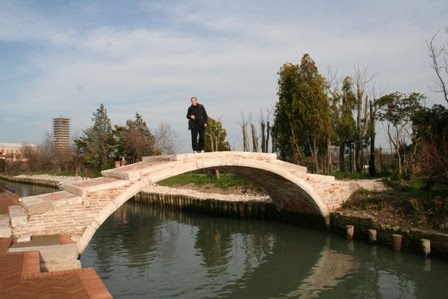
Torcello has a Devil’s Bridge over a small canal.  It is probably so called because it has no hand rails.  A visitor after indulging too well at Torcello's Locanda Cipriani, a restaurant almost as famous, and expensive, as Florian’s in St Marks Square, could well topple into the canal from the bridge.

Today Torcello is as Ruskin, James and so many others described it:  an island barely above sea level with a small group of buildings which includes the Basilica, the church and the belltower at one end, with a small population of guards, guides and souvenir sellers who welcome the visitor.  It is easy to imagine staying there for an extended period, observing the rise and fall of the tide, the cycle of the seasons beneath those open skies.

Observer
9 June 2010
email: longline8@gmail.com
Ref: 
W.D. Howell, "Venetian Life", 1867.
F.C. Hodgson, "The Early History of Venice" 
John Ruskin, "The Stones of Venice", 1879

Henry James, "Italian Hours" 1909
Ernest Hemingway, "Across the River and Into the Trees" Jonathan Cape, 1950
Daphne du Maurier, "Don't Look Now and Other Stories", Penguin, 1973David Hewson, "The Cemetery of Secrets" Pan Macmillan 2001


Thursday, April 15, 2010

Murano Glass


They have been making glass for over 700 years.  The industry has survived invasions, competition, wars, the invention of plastic, changing fashions, and previous economic collapse.  In spite of the broken windows in the abandoned foundries, the rotting boards on the docks that speak of hard times being endured on the island, it is difficult to believe that Murano will not once again undergo a revival of its craft

The shrine was made of glass: a glass mosaic Virgin and Child in the Byzantine style.  The floral offerings on the ledge below the icon were moulded glass in red, pink, yellow, orange, and blue.  The virgin bore her child like a medallion on her chest.  Her glance, alert, almost fearful was caught by something to her right.  Her gaze, intense yet distracted, rendered irrelevant the opulent ornamentation surrounding her.  What, the observer could only wonder, was she looking at?  On this damp grey day in early spring the shrine gleamed, refracting the light caught by the glass mosaics.

On Fondamente Cavour the shop windows glowed.  Glass in a myriad of colours and forms illuminated the town’s shopfronts.

It is glass that lures Venice’s visitors on the 40 minute vaporetto trip to the island of Murano.

Glassmaking probably began in Mesopotamia 4,500 years ago, but it was the Romans who industrialized it.  During that period glassmakers travelled throughout the empire freely exchanging ideas and techniques.

Twenty years after the death of Jesus Christ, the technique that revolutionized glass production, glassblowing, was developed in Jerusalem.  Glassmaking became a portable industry, producing lighter weight vessels than the available pottery and metal.  It was cheaper as well, for glass is easy to recycle.

Some historians believe the original glassworkers of Northern Italy were descendants of freed Syrian and Judean slaves who spread their craft through the Roman Empire.  Whoever these early craftsmen were, the tradition of glassmaking has deep roots in the area.  By the first century AD Northern Italy was exporting small coloured glass bowls.

In Hemingway’s Across the River and Into the Trees Richard Cantrell extols the masculine virtues of the Muranese – their resilience, their fishing and duck hunting skills, their fecundity. 

With its rows of solid brick buildings along the seafront and the workmanlike steel bridge over Murano’s Grand Canal, there is something masculine about Murano, in spite of its delicate, dazzling products.

Yet Murano’s early history is not about glass.  Unlike the nearby island of Torcello, during the first millennium Murano produced no glass.  The Muranese were refugees from besieged Roman cities, hunters, fishermen, salt harvesters and boatmen.

The Via Annia, a Roman road followed the Adriatic coast as far as the glassmaking centre of Aquileia.  The road passed through the ancient settlement of Altinum, and here it came close to the shore of the Venetian lagoon, close to the inner lagoon islands, including Murano.

Refugees from Altinum escaped Attila the Hun’s invasion of Italy in 452 A.D. by fleeing to these sparsely populated islands.  Within a few decades twelve of the lagoon communities, including Murano, formed a cooperative council, the first step towards a Venetian Republic.
,
When the Lombards invaded Northern Italy in 568 A.D. refugees once again streamed onto the lagoon islands and the Muranese continued to work as fishermen, salt traders, hunters of the waterbirds that abounded in the shallow backwaters of the lagoon.  They also controlled the port on the nearby island of St Erasmo and generated income by servicing and trading with vessels that used the port.

The new millennium saw Murano’s fortunes on the rise.  Proof of this was the island’s acquisition of its own saintly relics in 1125.  The remains of St Donatus and some remains of the dragon he slew were brought from Arezzo and installed in the renamed Church of Santa Maria e San Donato.  In Byzantine Europe any city worth its salt had to have its own saint, and saintly relics.

Then in 1291 the Venetian Doge Tiepolo changed Murano forever when he closed down the glass furnaces in Venice and moved them to the island.

During the years that followed this move the Venetians tried to retain the lead in glass production in Europe by isolating the glassmakers and imposing strict secrecy laws on them.  They well knew the value of trade secrets. 

The move benefited both the Venetians and the Muranese.  Venice acquired the space left vacant by the departing glassmakers, and ensured that only Venetians would trade in Venetian, now Murano, glass. 

In return the Muranese were provided with their very own medieval-style state of the art industrial estate.  They were elevated socially and their daughters married into the families of rich Venetian merchants.  The craftsmen immediately began to expand their product range, revived ancient glassmaking techniques, invented new ones.  They kept the balance of trade with Europe on the plus side for the merchants. 

Today tourists visit Murano as part of the Venetian experience to tour the glass museum and those glass factories open for inspection. 

They are following a well trodden path.  In the Middle Ages Murano was a popular destination for visitors from Venice who went to enjoy the clean air and to walk in the gardens.  By the 15th century Murano was famous all over Europe.  People came to watch the glassmaking process. 

Within two hundred years all Murano’s ‘secret’ manufacturing processes had been copied in other parts of Europe and it was no longer the remarkable destination it once had been.

In 1797 Napoleon invaded Venice, ending over a thousand years of republican government.  After Napoleon the Austrians took over as occupiers.  During the following decades travellers in the lagoon risked being pulled over by customs patrols.  Books, food or jewellery in their possession were often confiscated and heavy on-the-spot fines imposed.

By the mid-1800s few people risked visiting the islands, except for the young and adventurous.  Byron, Shelley and James Fennimore Cooper were numbered among those who braved the lagoon trip.

Murano suffered a further blow when the Austrians built a deep water shipping lane from Mestre to Lido and the Muranese lost their income from servicing shipping. 

Glassmaking did not die out entirely, however.  Although only five foundries survived, by the late 1800s Murano was back in commercial production.  The foundries turned out glass mosaic tiles as part of the restoration of Venice’s churches, in particular the mosaics in St Mark’s.

The resilience of the Muranese saw them ride the economic roller coaster of the 20th century, the wars, the sudden shifts in fashion.  Vittorio Tosa Borella led the glass revival on Murano in the early part of the twentieth century.  He was followed by equally talented and farsighted artisans.  But the Second World War brought hard times for the industry and in the years after the war Muranese craftsmen worked hard to regain their popularity and their customer base.

By 2001 Murano was once again turning a profit.  One third of the 5,000 people on the island worked on their own as artisans or shopkeepers.  27 industrial glassworks processed 13,000 metric tons of raw glass a year. 

Such a run of good fortune could not last.  The world wide economic collapse in 2008 shattered the tourist industry.  The glass artists of Murano fought back.  For Christmas 2009 they put on their usual glittering, colourful public display – an antidote to the bleakness of the northern winter. 

On a damp grey day in early spring in 2010 small groups of tourists wandered past the brightly lit windows of the glass shops, or sipped coffee in the restaurants.  Few were buying.

By afternoon the rain was falling, rivulets of light flowed from the front of the shopfronts into the canal.  A sudden surge of children released from school filled the street.  The children skittered across the iron bridge.  Their mothers, impeded by prams and strollers, calling warnings as they struggled to keep up with their charges.  Soon they were gone, mothers and children, down the lanes and alleys. 

A Venice bound vaporetto pulled in.  The few tourists rushed from the café beside the stop, jostled to board it without getting wet. 

In the momentary silence that followed the departure of the vaporetto the icon glimmered through the rain, the virgin still alert to whatever danger lurked nearby.

Observer